English
 Español
Personalised Cancer Care Alliance Position Paper 2.0 Officially Launched
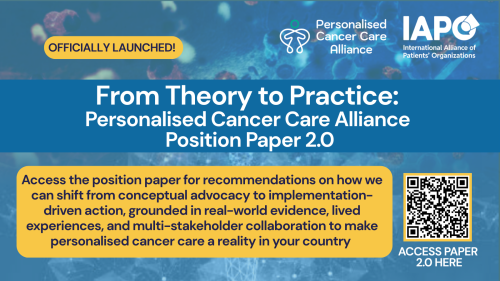
We are pleased to share that the Personalised Cancer Care Alliance (PCCA) Position Paper 2.0 was officially launched at a webinar held on 5 May!
The Position Paper 2.0 builds on the PCCA first Position Paper published in 2022, and recognises that the next stage of advocacy must move from theory to practice. It demonstrates a shift from conceptual advocacy to implementation-driven action, grounded in real-world evidence, lived experiences, and multi-stakeholder collaboration.
The paper is structured in three chapters and captures how the recommendations from the first Position Paper have been tested in real-world contexts through two pilot initiatives undertaken in 2024: one in Morocco and one across the Gulf Cooperation Council (GCC). It also introduces the work of the Gender Working Group, established to bring a stronger gender equity lens to personalised cancer care.
Overview of the three chapters
In Morocco, 12 patient organisations took part in a structured pre-assessment and national capacity-building workshop in Marrakech, conducted in collaboration with the AMAL Association as the co-host. Here they developed advocacy roadmaps to strengthen patient involvement, policy engagement, early detection, communication, and community-based support. The pilot demonstrated how patient organisations can move beyond service provision to become strategic partners in shaping national cancer care reform.
Across the GCC, patient organisations from 6 countries came together through a regional workshop in Dubai, held in collaboration with the Gulf Federation for Cancer Control. The workshop supported the co-creation of a regional activation roadmap focused on health literacy, stigma reduction, early detection, psychosocial support, access to advanced diagnostics, genomic testing, AI-driven advocacy, and stronger regional collaboration.
The Gender Working Group chapter highlights the specific barriers faced by women across the cancer care pathway, including stigma, late diagnosis, limited access to screening and diagnostics, financial barriers, and gaps in psychosocial, fertility, palliative, and survivorship support. It shows why gender equity must be central to efforts to advance personalised cancer care.
At the webinar, we also launched the Manila Workshop Report, which captures the collective discussions from the PCCA workshop held in Manila in November 2025 bringing together representatives of the Morocco and GCC pilots and the Gender Working Group. Majed Mohamed (Head of Community Engagement & Advocacy, Friends of Cancer Patients) who was a participant of the GCC and Manila workshops, presented the PCCA Roadmap in a video where you learn about the actionable commitments agreed by the participants.
We invite you to view and download the paper to read the full recommendations and learn more about how personalised cancer care can be advanced in practice.
If you missed the launch, you can rewatch the event here.
Download the PCCA Position Paper 2.0 here.